The new LIGO–Virgo–KAGRA Catalog sets new records in precision gravitational astronomy
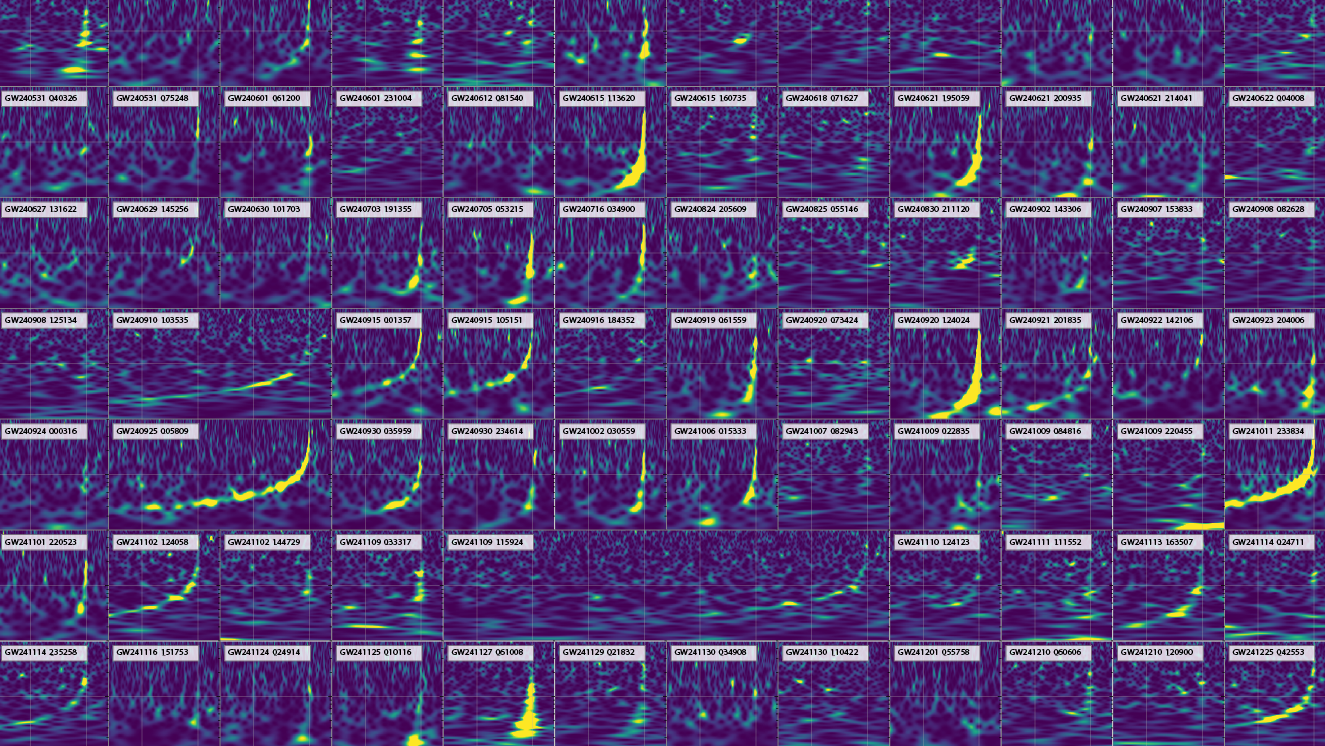
The LIGO–Virgo–KAGRA Collaboration published today a new catalog of gravitational wave events. A total of 161 events, detected between April 2024 and the end of January 2025, have been added to the collection, bringing the total number of gravitational wave signals detected to date to 390. Among the most significant findings are: evidence for the existence of second-generation black holes, the most precise sky localization ever achieved for a gravitational wave source, and the first measurement of three vibrational modes of a black hole. A wealth of results that marks the coming of age of gravitational astronomy.
The international network of gravitational wave detectors LIGO, Virgo and KAGRA (LVK) has announced today the online release of an updated catalog of all gravitational wave events observed to date, named the Gravitational Wave Transient Catalogue-5.0 (GWTC-5), with the corresponding scientific papers in submission to Astrophysical Journal and Astrophysical Journal Letters. The data analyzed in this work were collected by the detectors between April 2024 and the end of January 2025, during a portion of the fourth observing run (O4) known as O4b. During this period, 161 new gravitational wave events were detected, bringing the total number of confirmed events observed by the network since the first detection in 2015 to an astounding 390. The international LVK network consists of the twin detectors of the US National Science Foundation Laser Interferometer Gravitational-wave Observatory (NSF LIGO) , the Virgo detector hosted by the European Gravitational Observatory in Italy and the Japanese KAGRA hosted by the Institute for Cosmic Ray Research (ICRR) of the University of Tokyo.
This latest catalog update, together with the previous one GWTC-4, covering events collected between May 2023 and January 2024, contains 75% of all gravitational wave events observed so far since the first detection in 2015. This impressive result demonstrates how crucial detector upgrades are for increasing sensitivity, leading to an extraordinary growth in the number of detected events with each successive observing run. In fact the international LIGO–Virgo–KAGRA (LVK) Collaboration alternates periods of data collection (observing runs) with phases devoted to detector upgrades and commissioning. That’s also why the gravitational wave event catalog — including validated data and the physical parameters of the sources — is updated and shared with the wider scientific community periodically.
“The extraordinary sensitivity of our detectors,” said Ed Porter, researcher at the Laboratoire Astroparticule et Cosmologie (APC) of CNRS, “now allows us to capture three or four gravitational wave signals every week. This ever-growing wealth of data, which an entire community of scientists and astronomers is working to analyze and study, has taken us from the era of initial discoveries into that of precision gravitational astronomy. Today, gravitational wave studies make possible analyses that were previously unimaginable: investigations into black hole populations, increasingly precise tests of general relativity under the extreme physical conditions of the phenomena we observe, and the development of new methods to obtain ever more accurate estimates of the Hubble constant. It is a scenario that not many people would have bet on just ten years ago.”
In addition to the new perspectives opened by this extraordinary number of observations, the new catalog also includes several detections that are themselves exceptional and sets new records in gravitational-wave astronomy observations: the best sky localization ever achieved for a gravitational wave source, the clearest gravitational wave signal ever recorded, and evidence for the existence of second-generation black holes.
The best sky localization ever achieved
A signal detected by the two LIGO detectors in the United States and Virgo in Europe on June 15, 2024 — and therefore called GW240615 — set the record for the most precise sky localization among all gravitational wave events observed to date. The source was identified within an area of just 6 square degrees, a relatively small portion of the celestial sphere. This exceptional performance was achieved thanks to the triangulation using data from all three detectors active at the time, including Virgo, which rejoined the observing campaign in April 2024 at the beginning of O4b, contributing significantly to the network’s source-localization capabilities.
“Increasingly precise localization of sources in the sky is clearly one of the priorities for the entire astronomical community, in order to search within the smallest possible region of the sky for any electromagnetic signals generated by the observed events — especially in the case of neutron star mergers or mergers between a black hole and a neutron star ” - said Marie Anne Bizouard, spokesperson for the Virgo Collaboration, and researcher at the French National Centre for Scientific Research (CNRS) in Nice - “We knew that Virgo’s contribution would be decisive in improving the localization of observed gravitational wave sources, and we are proud of the outstanding work carried out by the team responsible for commissioning the detector, which has been rewarded by this record-setting result.”
The gravitational wave event observed with this record localization was the merger of two black holes, with masses of about 26 and 30 solar masses, which violently collided more than 3 billion light-years from Earth.
Improvements in the network’s ability to localize events, along with the increase in the size of the dataset, also allowed for a better estimate of the Hubble constant, H0 which indicates how fast the Universe is currently expanding. Using the GWTC-5 dataset, the LVK collaboration obtained a new, independent measurement of the Hubble constant, H0 = 71.0-7+9 km s-1 Mpc-1 , which is just over 25% more precise than the estimate coming from the previous catalog release. This value is entirely consistent with long-established measurements from both our cosmic neighbourhood and the early Universe but is not yet precise enough to resolve the tension between those measurements.
The Clearest gravitational wave Signal Ever Recorded
Detecting gravitational waves does not simply mean capturing a signal, but extracting it from the noise that disturbs the detectors. This requires intense noise-mitigation efforts and highly sophisticated data analyses, which is why the “strength” or “clarity” of a signal is expressed through the signal-to-noise ratio (SNR). The catalog published today includes the “clearest” gravitational wave signal ever detected, with a signal-to-noise ratio of 76.9. This signal, GW250114, reached Earth on January 14, 2025 and was generated by the merger of two black holes with nearly identical masses (32 and 34 times the mass of the Sun, respectively), occurring more than one billion light-years from Earth. Its “clarity” has led to some exceptional scientific results, which have already been published and announced by the LVK collaboration in recent months, including the most accurate test of general relativity ever performed and confirmation of Stephen Hawking’s black hole area theorem.
“When two black holes merge, the collision rings like a bell, emitting specific tones characterized by two numbers an oscillatory frequency and a damping time.” said Cornell University physicist Keefe Mitman, “If you measure one tone in data from a collision, you can calculate the mass and spin of the black hole formed in the collision. But if you measure two or more tones in the data – which a clear signal such as GW250114 allows – each of those is effectively giving you a different mass and spin measurement, according to general relativity.
“If those two measurements agree with one another, you are effectively verifying general relativity,” Mitman said. “But if you measure two tones that don’t match up with the same mass and spin combination, you can start to probe how much you’ve deviated away from GR’s predictions.” GW250114 was clear enough for the researchers to measure two tones and constrain a third. All agree with Einstein’s general relativity.
Second Generation Black Holes
Another outstanding result, included in the new catalog published today—though it had already been announced by the LVK Collaboration in recent months—concerns two very special events: GW241011 and GW241110. These signals, detected in October and November 2024, just one month apart, were generated by two black hole mergers, located approximately 700 million and 2.4 billion light-years from Earth, respectively. Certain characteristics of these mergers — in particular the spin of the black holes (that is, the orientation and speed of their rotations) — indicate the objects involved could be ‘second-generation’ black holes, meaning black holes that are themselves the result of previous coalescences. These objects likely formed in very dense and crowded cosmic environments, such as stellar clusters, where black holes are more likely to collide and merge repeatedly. The growing number of observed events has also enabled researchers to study and increasingly clearly identify the properties of different populations of black holes, and one of the articles accompanying the Catalogue deals precisely with this specific aspect.
“One of the most intriguing clues emerging from the new catalog is the appearance of a group of black holes with masses between about 10 and 20 times the mass of the Sun that seem to share a common feature: they are spinning rapidly, likely being ‘second generation’ black holes - said Mario Spera, researcher of the Virgo Collaboration at SISSA - The puzzle is not simply that these black holes spin fast, but why this subpopulation appears precisely at these masses. It is another hint that the Universe may still be hiding important pieces of the story of how black holes are born, evolve and merge. And this picture will become richer, and more surprising, with every new gravitational-wave catalog by LVK”
The LIGO-Virgo-KAGRA Collaboration
LIGO is funded by the NSF and operated by Caltech and MIT, which together conceived and built the project. Financial support for the Advanced LIGO project was led by the NSF with Germany (Max Planck Society), the United Kingdom (Science and Technology Facilities Council), and Australia (Australian Research Council) making significant commitments and contributions to the project. More than 1,600 scientists from around the world participate in the effort through the LIGO Scientific Collaboration, which includes the GEO Collaboration. Additional partners are listed at my.ligo.org/census.php.
The Virgo Collaboration is currently composed of approximately 1.000 members from 175 institutions in 20 different (mainly European) countries. The European Gravitational Observatory (EGO) hosts the Virgo detector near Pisa in Italy, and is funded by Centre National de la Recherche Scientifique (CNRS) in France, the National Institute of Nuclear Physics (INFN) in Italy, the National Institute of Subatomic Physics (Nikhef) in the Netherlands, The Research Foundation – Flanders (FWO) and the Belgian Fund for Scientific Research (F.R.S.–FNRS). A list of the Virgo Collaboration groups can be found at: https://www.virgo-gw.eu/about/scientific-collaboration/ More information is available on the Virgo website at https://www.virgo-gw.eu
KAGRA is the laser interferometer with 3-kilometer arm length in Kamioka, Gifu, Japan. The host institute is the Institute for Cosmic Ray Research (ICRR), the University of Tokyo, and the project is co-hosted by National Astronomical Observatory of Japan (NAOJ) and High Energy Accelerator Research Organization (KEK). KAGRA collaboration is composed of more than 400 members from 128 institutes in 17 countries/regions. KAGRA’s information for general audiences is at the website gwcenter.icrr.u-tokyo.ac.jp/en/. Resources for researchers are accessible from gwwiki.icrr.u-tokyo.ac.jp/JGWwiki/KAGRA.
Image credits: Derek Davis / University of Rhode Island / LIGO - Virgo - KAGRA
You may be interested

A WEEKEND EXPLORING GRAVITATIONAL WAVES WITH EGO AND VIRGO

Virgo’s virtual tour returns with Pico New Horizons project
EGO and Virgo are taking part in the European Researchers Night with Bright Night and PICO

Two instrumented baffles installed in Virgo by IFAE Barcelona

Gravitational wave detectors can now ‘auto-tune’ their signals
Contacts
Via E. Amaldi,5
56021 Cascina (PI) - Italy
Tel +39 050 752511
Contact us
How to reach us
Stay Tuned
EGO is a consortium of