Inauguration of Palpita: Pedro Torres engages with gravitational waves
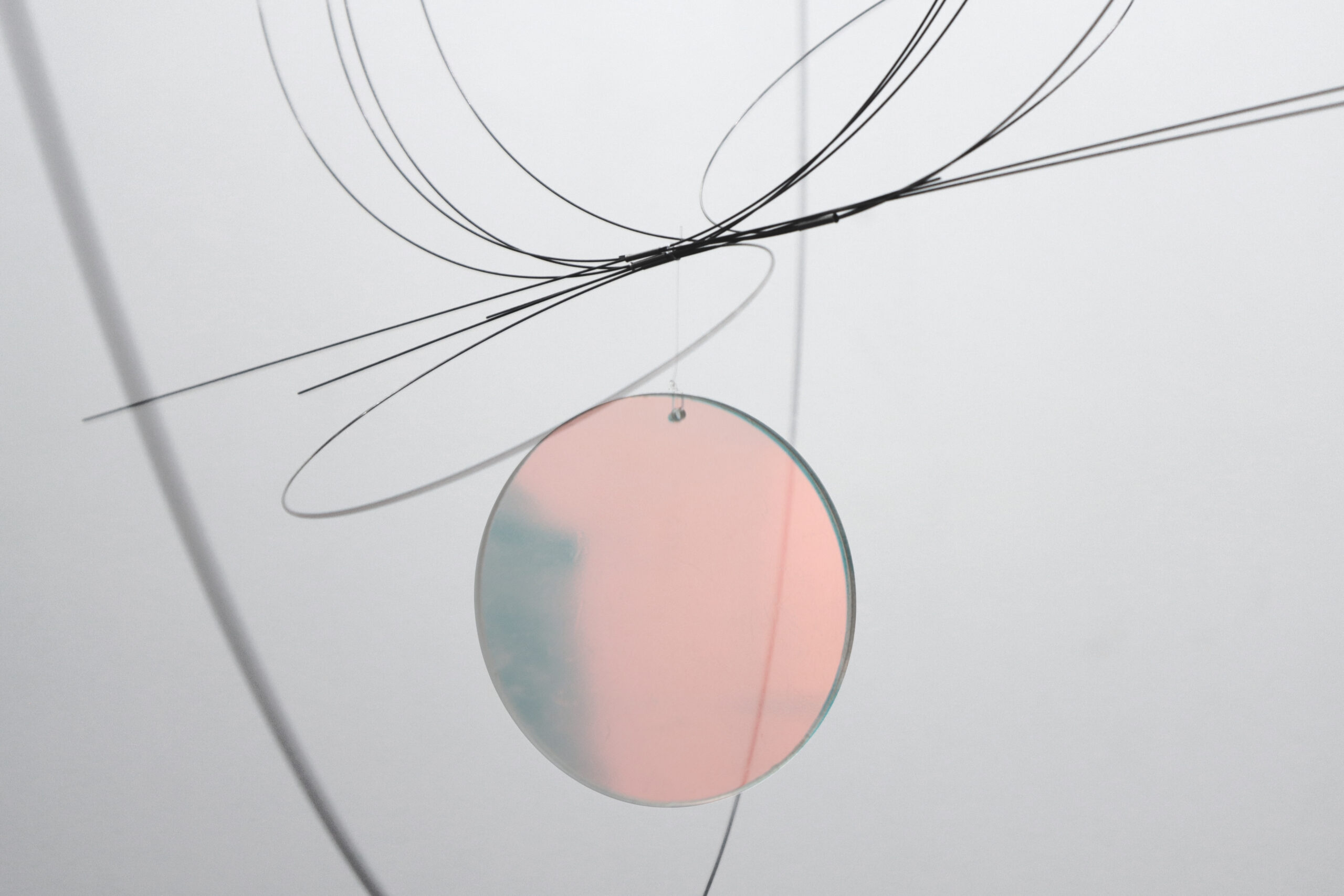
Palpita, an exhibition by Brazilian artist Pedro Torres curated by Carolina Ciuti, opens today in Rome at AlbumArte, in collaboration with the European Gravitational Observatory (EGO), which is home to Virgo, one of the world’s four gravitational wave detectors. The project stems from Torres’s collaboration with scientists from EGO/Virgo.
On Tuesday 17 March 2026, AlbumArte, an independent production centre for artistic research, opens Palpita, a new exhibition by Pedro Torres (born in Gloria de Dourados, Brazil, in 1982; lives and works in Barcelona), curated by Carolina Ciuti, which will run until 13 May. The exhibition offers an immersive and perceptive experience, in which light, sound and space become tools for exploring time as a complex, layered and unstable dimension. The project is realised with the support of the Institut Ramon Llull and in collaboration with EGO/Virgo, the Real Academia de España en Roma and AlbumArte.
Torres’s artistic practice lies at the intersection of scientific knowledge and poetry.
Through videos and light and sound installations, the artist explores natural phenomena without ever reducing them to illustrative or didactic representations, but rather by transforming data, theories and experiments into immersive experiences that stimulate a sensitive and intuitive perception.
A seminal work that precedes his current research is the installation Fisura, presented at the Real Academia de España in Rome. Based on the principles of light interference and diffraction, the work presented itself as a ‘failed scientific apparatus’: a complex system of optical, light and sound elements that defied an immediate understanding of the phenomenon, documenting light filtered through the slow movement of a set of Venetian blinds.
Palpita continues this exploration, shifting the focus to gravitational waves. The project stems from collaboration with researchers at EGO, the observatory in Cascina in the province of Pisa, which hosts one of the planet’s four gravitational wave detectors – the Virgo experiment – and from an interest in interferometry as a tool capable of detecting phenomena otherwise invisible to human experience.
Gravitational waves – infinitesimal ripples in space-time produced by extreme cosmic events – are not merely a subject of study for Torres, but a poetic possibility: a way of imagining time as vibrating matter, a trace and echo of events that have already occurred, yet are still propagating.
The site-specific installation for AlbumArte weaves together visual, auditory and tactile stimuli, evoking a vital, almost imperceptible pulse. Palpita unfolds through analogies, resonances and shifts in meaning: the pulse suggested by the title becomes a metaphor for the pulsation of time, for its capacity to accumulate, transmit and transform information.
Rome, a city of historical layers and persistent memories, amplifies this reflection: gravitational waves enter into dialogue with the archaeological and historical time of the city, placing the audience between the infinitely remote and the here and now of the experience, between scientific precision and perceptual uncertainty.
In this context, the collaboration with EGO is not limited to a thematic reference, but becomes a shared ground for exploring the limits of perception and the need to develop new languages to describe phenomena that go beyond everyday experience. In Palpita, science and poetic intuition thus merge, offering the possibility of inhabiting a liminal space where time does not flow, but pulses.
OPENING CEREMONY
Tuesday 17 March 2026, from 6.30 pm
Free admission
OPENING HOURS: Wednesday, Thursday and Friday from 4.00 pm to 7.00 pm
AlbumArte, Via Flaminia 122, Rome
Exhibition organised with the support of the Institut Ramon Llull and in collaboration with the European Gravitational Observatory (EGO), the Real Academia de España en Roma and AlbumArte.
Pedro Torres (born in Gloria de Dourados, Brazil, in 1982; lives and works in Barcelona) has held solo exhibitions and taken part in group shows and biennials in Spain, France, Italy, Ecuador, Colombia, Argentina, Mexico, Turkey and China. Among the numerous awards he has received are a residency and production grant at Tabacalera Madrid / Ministry of Culture, the Ankaria Artist Book Award, the grant from the Royal Academy of Spain in Rome, the Production Call for Proposals by the “la Caixa” Foundation, the visual arts grant from the Botín Foundation, Barcelona Crea and, on several occasions, research grants from OSIC on behalf of the Department of Culture of the Government of Catalonia.
His works form part of the collections of MACBA, INELCOM, the Fundación Botín, the Blueproject Foundation, the olorVISUAL collection, the Colección Untitled and other private collections.
EGO, the European Gravitational Observatory, located in Cascina, in the Pisa countryside, is home to the Virgo experiment, the only gravitational-wave detector in Europe and one of only four in the world. Gravitational waves are extremely faint cosmic signals that allow us to observe extraordinary phenomena in the deep Universe, such as the merger of black holes or stars. Around 1,000 scientists from 20 countries contribute to the Virgo scientific collaboration. The European Gravitational Observatory (EGO) is funded by the Centre National de la Recherche Scientifique (CNRS) in France, the National Institute for Nuclear Physics (INFN) in Italy, the National Institute for Subatomic Physics (Nikhef) in the Netherlands, the Research Foundation Flanders (FWO) and the Belgian Fund for Scientific Research (F.R.S.-FNRS). EGO is also involved in public outreach projects, events, installations and exhibitions at the intersection of art and science, artist residencies and citizen science activities.
You may be interested

Gravitational wave research leads to a new patent for space travel
Marie Anne Bizouard elected as spokesperson of Virgo: she will be the first woman in this role
Alain Brillet passed away. He was one of the fathers of gravitational wave research
The PAS Rome meeting 2026 at the Polish Embassy in Rome
The LIGO – Virgo – KAGRA gravitational wave community meeting in Italy again after 15 years


Contacts
Via E. Amaldi,5
56021 Cascina (PI) - Italy
Tel +39 050 752511
Contact us
How to reach us
Stay Tuned
EGO is a consortium of